
In 2022 after much thought, I changed my pronouns. I have identified as gender fluid since the days when it took several paragraphs to explain, and I am quite happy that we now have a simple way of describing it. But as pronouns have become more important I have been left with a dilemma.
In the 1980s when I was at university ‘he’ was still the default in almost all our textbooks, monographs, articles and essays. Insisting on ‘she’ or s/he’ was a radical act.
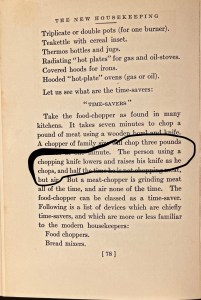
This is a nice example I saw at the Disability and Design exhibit at the V&A in 2025. This is directed to women yet it uses the universal ‘he’.
As such, I was content with ‘she’. On one level I still am, in that in terms of the way I am treated in the world, and the people I identify with, I am part of the class, ‘woman’.
In the last decade, however, pronouns have come to mean gender identity. I have no objection but it left me struggling; while my class is woman, my gender identity is not; in addition, ‘they’ has come to indicate non-binary, which is not how I feel.
With this in mind, I prefer that people in the academic and convention/critical world either use my name (Farah or Farah Mendlesohn)–preferably having checked the spelling first!–or if the sentence gets too unwieldy, use they. That said, as I am gender fluid, I won’t get too upset (and haven’t in the past when I got he a lot from people who hadn’t met me) if you get it wrong. For other people it matters intensely and we all need to respect that. I happen to have such a weak and flexible (context responsive) sense of gender identity that it doesn’t grate much.
FJM, 15 July 2025
——
Farah Mendlesohn was Professor and Head of Department of English and Media at Anglia Ruskin University from 2012-2017, then Associate Dean of Recruitment at Staffordshire University, and is now Emerita Professor at Anglia Ruskin University.
Most significant work:
- The Cambridge Companion to Science Fiction, 2005 with Edward James
- Rhetorics of Fantasy (2009),
- The Inter-galactic Playground: A Critical Study of Children’s and Teens’ Science Fiction (McFarland)
- Diana Wynne Jones: The Fantastic Tradition and Children’s Literature (Routledge).
- Children’s Fantasy Literature: An Introduction, written with long time colleague Professor Michael M. Levy won the World Fantasy Award in 2017.
- The Pleasant Profession of Robert A. Heinlein, 2019
- Creating Memory: Historical Fiction and the English Civil Wars, 2020.
- Forthcoming: Considering the Female Man, by Joanna Russ, or, as the Bear Swore, 2026.
Service:
- Editor, Foundation: the International Review of Science Fiction,2001-2007
- Chair of the Science Fiction Foundation, 2004-2007
- President of the International Association of the Fantastic in the Arts from 2008-2011
- Treasurer of the BSFA, 2021-2026.
- Head of Program for Discon III, World Science Fiction Convention, Washington, 2021.
- Convenor of the new Historical Fictions Research Network, Anglia Ruskin University, February 2016; the National Maritime Museum 2017; Trentham, Stoke-On-Trent, 2018; Manchester 2019; Online 2020 & 2021.
- Director of Exhibits for Loncon3, the 72nd Science Fiction World Convention, Excel Centre, London in 2014.
- 2009 Programme Director for Anticipation, World Science Fiction Convention, Montreal.
- John W. Campbell Award Juror, 2003 and 2004.
- Judge for 2003 Francelia Butler Conference Prize at Hollins College, Roanoke, VA
- James Tiptree Jr. Award Juror, 2002.
- Arthur C. Clarke Award Judge, 1997 and 1998.

 Farah Mendlesohn